Cyperaceae taxon details
Carex quinquin Jim.Mejías & Dorr

1676916 (urn:lsid:marinespecies.org:taxname:1676916)
accepted
Species
Uncinia chlorostachya Phil. · unaccepted
Uncinia durvillei Steud. · unaccepted > misspelling - incorrect subsequent spelling
Uncinia loliacea Phil. · unaccepted
Uncinia longispica Boeckeler · unaccepted
Uncinia trichocarpa C.A.Mey. · unaccepted (Substituted name (Replacement...)
Substituted name (Replacement name: Carex quinquin Jim.Mejías & Dorr)
Uncinia trichocarpa var. longispica (Boeckeler) Kük. · unaccepted
Uncinia urvillei Steud. · unaccepted > heterotypic synonym
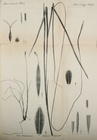
(of Uncinia trichocarpa C.A.Mey.) Meyer, C. A. (1831). Cyperaceae novae descriptionibus et iconibus illustratae. <em>Mémoires présentés à l'Académie Impériale des Sciences de St.-Pétersbourg par divers savants et lus dans ses assemblées.</em> 1: 195-230., available online at https://www.biodiversitylibrary.org/page/37114463
page(s): 11, t.4 [details]
page(s): 11, t.4 [details]
Description Plants perennial, caespitose from short rhizomes. Fertile culms ca. 20–80 cm, 0.8–1.3 mm wide at the middle, usually...
Etymology The species epithet comes from quinquín, the vernacular name of Carex phleoides–like plants in southern Chile, derived...
Description Plants perennial, caespitose from short rhizomes. Fertile culms ca. 20–80 cm, 0.8–1.3 mm wide at the middle, usually shortly exceeding the leaves, trigonous, smooth. Leaves not rigid, herbaceous, widest ones 3.5–7 mm wide, flattish, margins and tip antrorsely scabrous. Inflorescences a solitary, androgynous spike, 6–18 cm, cylindrical to subclavate-cylindrical, 4.5–9 mm at its widest, rather laxly flowered, with the utricles ascendant-spreading, the staminate portion 0.6–1.3 cm, bractless. Female glumes from the middle part of the spike 6–7.4(7.5) × 1.8–2.4 mm, shorter than the utricles, ovate to elliptic, obtuse to acute, glabrous, coriaceous, whitish green, stramineous, or pale brown, sometimes darker at center, often with the upper margin reddish brown tinged, ciliolate, rarely the entire glume uniformly dark brown, faintly 5- to 9-veined. Utricles (6.2)6.5–8.4(9) × 1.1–1.5(1.8) mm, oblong-elliptic, pale brown to brown, often reddish brown streaked, appressed-scabrid distally, smooth (or nearly so) proximally, margins ciliate with hairs in fascicles, with 2 prominent lateral costae and sides veinless or faintly veined, attenuated at the top into a conic beak, the empty portion between the achene top and the utricle tip 1–1.7(1.8) mm. Achenes 4–5.6 × 1–1.7 mm, narrowly elliptic to oblong, compressed-trigonous. Rachilla smooth or scabrid on the adaxial side of the hook, with the exserted portion 2.6–6 mm. [details]
Etymology The species epithet comes from quinquín, the vernacular name of Carex phleoides–like plants in southern Chile, derived...
Etymology The species epithet comes from quinquín, the vernacular name of Carex phleoides–like plants in southern Chile, derived from the Mapuche words culin or culican, which mean “fishing device”, in clear reference to the hooked rachilla of Uncinia species. [details]
Cyperaceae Working Group. (2026). [see How to cite]. Global Cyperaceae Database. Carex quinquin Jim.Mejías & Dorr. Accessed at: https://www.cyperaceae.org/aphia.php?p=taxdetails&id=1676916 on 2026-11-16
Date
action
by
 The webpage text is licensed under a Creative Commons
Attribution 4.0 License
Nomenclature
original description
(of Uncinia longispica Boeckeler) Böckeler, O. (1858). Neue Cyperaceen. <em>Flora.</em> 41(40): 643-651., available online at https://www.biodiversitylibrary.org/page/51062#page/634/mode/1up
page(s): 650 [details]
original description (of Uncinia trichocarpa C.A.Mey.) Meyer, C. A. (1831). Cyperaceae novae descriptionibus et iconibus illustratae. <em>Mémoires présentés à l'Académie Impériale des Sciences de St.-Pétersbourg par divers savants et lus dans ses assemblées.</em> 1: 195-230., available online at https://www.biodiversitylibrary.org/page/37114463
page(s): 11, t.4 [details]
original description (of Uncinia chlorostachya Phil.) Philippi, R. A. (1865). Plantarum novarum Chilensium centuriae, inclusis quibusdam Mendocinis et Patagonicis. <em>Linnaea.</em> 33: 1-308., available online at https://www.biodiversitylibrary.org/page/118883
page(s): 275 [details]
original description (of Uncinia loliacea Phil.) Philippi, R.A. (1896). Plantas nuevas chilenas. <em>Anales de la Universidad de Chile.</em> 93: 475-506., available online at https://www.biodiversitylibrary.org/page/49930244#page/515/mode/1up
page(s): 503 [details]
original description (of Uncinia urvillei Steud.) Steudel, E. G. (1855). Synopsis Plantarum Glumacearum. II. Cyperaceae. Metzler. Stuttgart. 246 pp., available online at https://www.biodiversitylibrary.org/page/44896084#page/8/mode/1up
page(s): 243 [details]
replacement name source Jiménez-Mejías, P.; Dorr, L. J. (2018). The quinquín sedges: Taxonomy of the Carex phleoides group (Cyperaceae). <em>Annals of the Missouri Botanical Garden.</em> 103(4): 591-603., available online at https://doi.org/10.3417/2018125 [details] Available for editors [request]
page(s): 650 [details]
original description (of Uncinia trichocarpa C.A.Mey.) Meyer, C. A. (1831). Cyperaceae novae descriptionibus et iconibus illustratae. <em>Mémoires présentés à l'Académie Impériale des Sciences de St.-Pétersbourg par divers savants et lus dans ses assemblées.</em> 1: 195-230., available online at https://www.biodiversitylibrary.org/page/37114463
page(s): 11, t.4 [details]
original description (of Uncinia chlorostachya Phil.) Philippi, R. A. (1865). Plantarum novarum Chilensium centuriae, inclusis quibusdam Mendocinis et Patagonicis. <em>Linnaea.</em> 33: 1-308., available online at https://www.biodiversitylibrary.org/page/118883
page(s): 275 [details]
original description (of Uncinia loliacea Phil.) Philippi, R.A. (1896). Plantas nuevas chilenas. <em>Anales de la Universidad de Chile.</em> 93: 475-506., available online at https://www.biodiversitylibrary.org/page/49930244#page/515/mode/1up
page(s): 503 [details]
original description (of Uncinia urvillei Steud.) Steudel, E. G. (1855). Synopsis Plantarum Glumacearum. II. Cyperaceae. Metzler. Stuttgart. 246 pp., available online at https://www.biodiversitylibrary.org/page/44896084#page/8/mode/1up
page(s): 243 [details]
replacement name source Jiménez-Mejías, P.; Dorr, L. J. (2018). The quinquín sedges: Taxonomy of the Carex phleoides group (Cyperaceae). <em>Annals of the Missouri Botanical Garden.</em> 103(4): 591-603., available online at https://doi.org/10.3417/2018125 [details] Available for editors
[request]Taxonomy
taxonomy source
Muñoz-Schüler, P.; García-Moro, P.; Márquez-Corro, J. I.; Penneckamp, D.; Sanz-Arnal, M.; Martín-Bravo, S.; Jiménez-Mejías, P. (2023). The genus Carex (Cyperaceae) in Chile: a general update of its knowledge, with an identification key [El género Carex (Cyperaceae) en Chile: una actualización general de su conocimiento, con una clave de identificación]. Gayana - Botanica, 80(2): 103-132., available online at https://doi.org/10.4067/S0717-66432023000200103 [details] Available for editors [request]
[request] Present Inaccurate Introduced: alien Containing type locality
From editor or global species database
Description Plants perennial, caespitose from short rhizomes. Fertile culms ca. 20–80 cm, 0.8–1.3 mm wide at the middle, usually shortly exceeding the leaves, trigonous, smooth. Leaves not rigid, herbaceous, widest ones 3.5–7 mm wide, flattish, margins and tip antrorsely scabrous. Inflorescences a solitary, androgynous spike, 6–18 cm, cylindrical to subclavate-cylindrical, 4.5–9 mm at its widest, rather laxly flowered, with the utricles ascendant-spreading, the staminate portion 0.6–1.3 cm, bractless. Female glumes from the middle part of the spike 6–7.4(7.5) × 1.8–2.4 mm, shorter than the utricles, ovate to elliptic, obtuse to acute, glabrous, coriaceous, whitish green, stramineous, or pale brown, sometimes darker at center, often with the upper margin reddish brown tinged, ciliolate, rarely the entire glume uniformly dark brown, faintly 5- to 9-veined. Utricles (6.2)6.5–8.4(9) × 1.1–1.5(1.8) mm, oblong-elliptic, pale brown to brown, often reddish brown streaked, appressed-scabrid distally, smooth (or nearly so) proximally, margins ciliate with hairs in fascicles, with 2 prominent lateral costae and sides veinless or faintly veined, attenuated at the top into a conic beak, the empty portion between the achene top and the utricle tip 1–1.7(1.8) mm. Achenes 4–5.6 × 1–1.7 mm, narrowly elliptic to oblong, compressed-trigonous. Rachilla smooth or scabrid on the adaxial side of the hook, with the exserted portion 2.6–6 mm. [details]Etymology The species epithet comes from quinquín, the vernacular name of Carex phleoides–like plants in southern Chile, derived from the Mapuche words culin or culican, which mean “fishing device”, in clear reference to the hooked rachilla of Uncinia species. [details]

To Biodiversity Heritage Library (18 publications) (from synonym Uncinia trichocarpa C.A.Mey.)
To Biodiversity Heritage Library (2 publications) (from synonym Uncinia durvillei Steud.)
To Biodiversity Heritage Library (2 publications) (from synonym Uncinia chlorostachya Phil.)
To Biodiversity Heritage Library (2 publications) (from synonym Uncinia loliacea Phil.)
To Biodiversity Heritage Library (5 publications) (from synonym Uncinia longispica Boeckeler)
To International Plant Names Index (IPNI) (from synonym Uncinia trichocarpa C.A.Mey.)
To International Plant Names Index (IPNI) (from synonym Uncinia loliacea Phil.)
To International Plant Names Index (IPNI) (from synonym Uncinia longispica Boeckeler)
To International Plant Names Index (IPNI) (from synonym Uncinia chlorostachya Phil.)
To International Plant Names Index (IPNI)
To International Plant Names Index (IPNI) (from synonym Uncinia urvillei Steud.)
To International Plant Names Index (IPNI) (from synonym Uncinia trichocarpa var. longispica (Boeckeler) Kük.)
To International Plant Names Index (IPNI) (from synonym Uncinia durvillei Steud.)
To International Plant Names Index (IPNI) (from synonym Uncinia phleoides var. trichocarpa (C.A.Mey.) C.B.Clarke)
To Plants of the World Online (from synonym Uncinia phleoides var. longispica (Boeckeler) C.B.Clarke)
To Plants of the World Online (from synonym Uncinia phleoides var. trichocarpa (C.A.Mey.) C.B.Clarke)
To Plants of the World Online (from synonym Uncinia trichocarpa var. longispica (Boeckeler) Kük.)
To Plants of the World Online (from synonym Uncinia durvillei Steud.)
To Plants of the World Online (from synonym Uncinia chlorostachya Phil.)
To Plants of the World Online (from synonym Uncinia urvillei Steud.)
To Plants of the World Online
To Plants of the World Online (from synonym Uncinia loliacea Phil.)
To Plants of the World Online (from synonym Uncinia longispica Boeckeler)
To Plants of the World Online (from synonym Uncinia trichocarpa C.A.Mey.)
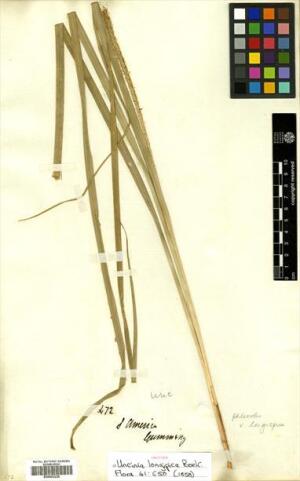
To Royal Botanic Garden Edinburgh Herbarium (Uncinia longispica E00502227 isotype 1) (from synonym Uncinia longispica Boeckeler)
To Royal Botanic Garden Edinburgh Herbarium (Uncinia longispica E00502228 isotype 1) (from synonym Uncinia longispica Boeckeler)