Cyperaceae taxon details
Carex jonesii L.H.Bailey
1676521 (urn:lsid:marinespecies.org:taxname:1676521)
accepted
Species
Carex nervina var. jonesii (L.H.Bailey) Kük. · unaccepted
terrestrial
Bailey, L. H. (1889). Studies of the types of various species of the genus <i>Carex</i>. Notes on <i>Carex</i>.—XI. <em>Memoirs of the Torrey Botanical Club.</em> 1(1): 1-86., available online at https://www.biodiversitylibrary.org/page/31679539#page/7/mode/1up
page(s): 16 [details]
page(s): 16 [details]
Description Plants with basal sheaths of previous year persistent as linear fibers. Culms to 60 cm × 2 mm, usually scabrous abaxially....
Taxonomic remark Source in seed data: wcs Update namepublishedIn from Mem. Torrey Bot. Club 1: 16 1889 to Mem. Torrey Bot. Club 1: 16...
Description Plants with basal sheaths of previous year persistent as linear fibers. Culms to 60 cm × 2 mm, usually scabrous abaxially. Leaves: proximal sheaths usually all with blades, fronts hyaline, smooth, apex colorless, hyaline, concave, entire; ligules obtuse, 5 mm, free limb to 0.2 mm; blades clustered at base, not epistomic, to 60 cm × 4 mm. Inflorescences very condensed, ovoid to shortly cylindric, with 5–10 individually indistinguishable branches, to 2.5 × 1.5 cm; proximal internodes not visible, not more than 3 mm; proximal bract scalelike, inconspicuous. Scales hyaline, dark brown, subequal to perigynia, acute. Perigynia pale brown, 7–11-veined abaxially, 5–7-veined adaxially, to 3.5 × 1.5 mm, base not distended proximally, rounded or cordate; stipe to 0.1 mm; beak to 1.5 mm, smooth or subserrulate, apex entire, oblique or, sometimes, bidentate with teeth to 0.1 mm. Achenes ovate, to 1.5 × 1 mm; persistent style base cylindric.
[details]
[details]
Taxonomic remark Source in seed data: wcs Update namepublishedIn from Mem. Torrey Bot. Club 1: 16 1889 to Mem. Torrey Bot. Club 1: 16...
Taxonomic remark Source in seed data: wcs Update namepublishedIn from Mem. Torrey Bot. Club 1: 16 1889 to Mem. Torrey Bot. Club 1: 16 (1889), information provided by Alan E. on email Jun. 07 2021 More details could be found in [details]
Cyperaceae Working Group. (2025). [see How to cite]. Global Cyperaceae Database. Carex jonesii L.H.Bailey. Accessed at: https://cyperaceae.org/aphia.php?p=taxdetails&id=1676521 on 2026-09-22
Date
action
by
2024-12-10 11:47:54Z
unchecked
db_admin
 The webpage text is licensed under a Creative Commons
Attribution 4.0 License
Nomenclature
original description
Bailey, L. H. (1889). Studies of the types of various species of the genus <i>Carex</i>. Notes on <i>Carex</i>.—XI. <em>Memoirs of the Torrey Botanical Club.</em> 1(1): 1-86., available online at https://www.biodiversitylibrary.org/page/31679539#page/7/mode/1up
page(s): 16 [details]
basis of record Plants of the World Online (POWO). , available online at https://powo.science.kew.org/ [details]
page(s): 16 [details]
basis of record Plants of the World Online (POWO). , available online at https://powo.science.kew.org/ [details]
 Present Inaccurate Introduced: alien Containing type locality
Syntype G 00191542, geounit Nevada [details]
From editor or global species database
Description Plants with basal sheaths of previous year persistent as linear fibers. Culms to 60 cm × 2 mm, usually scabrous abaxially. Leaves: proximal sheaths usually all with blades, fronts hyaline, smooth, apex colorless, hyaline, concave, entire; ligules obtuse, 5 mm, free limb to 0.2 mm; blades clustered at base, not epistomic, to 60 cm × 4 mm. Inflorescences very condensed, ovoid to shortly cylindric, with 5–10 individually indistinguishable branches, to 2.5 × 1.5 cm; proximal internodes not visible, not more than 3 mm; proximal bract scalelike, inconspicuous. Scales hyaline, dark brown, subequal to perigynia, acute. Perigynia pale brown, 7–11-veined abaxially, 5–7-veined adaxially, to 3.5 × 1.5 mm, base not distended proximally, rounded or cordate; stipe to 0.1 mm; beak to 1.5 mm, smooth or subserrulate, apex entire, oblique or, sometimes, bidentate with teeth to 0.1 mm. Achenes ovate, to 1.5 × 1 mm; persistent style base cylindric.[details]
Taxonomic remark Source in seed data: wcs Update namepublishedIn from Mem. Torrey Bot. Club 1: 16 1889 to Mem. Torrey Bot. Club 1: 16 (1889), information provided by Alan E. on email Jun. 07 2021 More details could be found in [details]

To Biodiversity Heritage Library (31 publications)
To European Nucleotide Archive, ENA (Carex jonesii)
To GenBank (15 nucleotides; 3 proteins)
To Genève Herbarium (Carex jonesii G00191542 type 1)
To International Plant Names Index (IPNI)
To International Plant Names Index (IPNI) (from synonym Carex nervina var. jonesii (L.H.Bailey) Kük.)
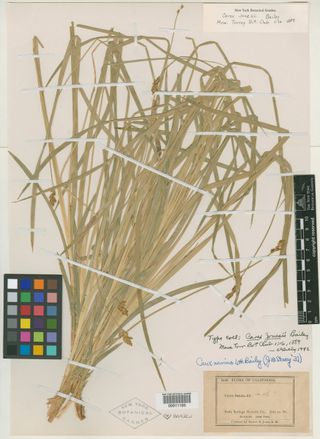
To New York Botanical Garden Steere Herbarium (Carex_jonesii_NY11185_type_1)
To Plants of the World Online (from synonym Carex nervina var. jonesii (L.H.Bailey) Kük.)
To Plants of the World Online
From editor or global species database

Hosted externally
Hosted externally